11/25/2026 by Christine Morris
Chinese New Year Shipping Delays Start Earlier Than You Think
One date that gets all the attention in the coming weeks is February 6th, the start of Chinese New Year. But shipping delays can start well before the holiday begins and continue long after it ends. Those are the weeks transportation managers really need to watch.
Because Chinese New Year isn’t just a February problem. It’s a multi-week planning challenge that can affect everything from production and ocean capacity to drayage, warehouse receiving, and final delivery.
Without a plan, the effects can show up as inventory shortages, delayed product launches, missed sales opportunities, higher transportation costs, or freight that gets pushed to later sailings.
Key Takeaways
- Chinese New Year shipping delays can begin weeks before February 6, 2027 and continue into March.
- Many factories close or significantly reduce production for 2-4 weeks, while the full slowdown and recovery cycle can last considerably longer, anywhere from 6-10 weeks.
- The freight impact often comes in 2 waves: a concentrated pre-holiday surge, followed by a lull and then another surge as factories ramp production back up.
- Shippers should begin communicating anticipated volumes 60–90 days in advance, including cargo-ready dates and estimated container counts by port of discharge.
- On the North American side, the biggest constraint may not be the drayage move itself. Appointment availability, chassis, container dwell, and warehouse/DC receiving capacity can become the real bottlenecks.
- If you’re already behind, separate what’s on the water from what hasn’t shipped. Those are two different problems with different solutions.
The Chinese New Year Shipping Timeline
Chinese New Year supply chain disruption doesn’t happen all at once. Here’s what to watch and when to act.
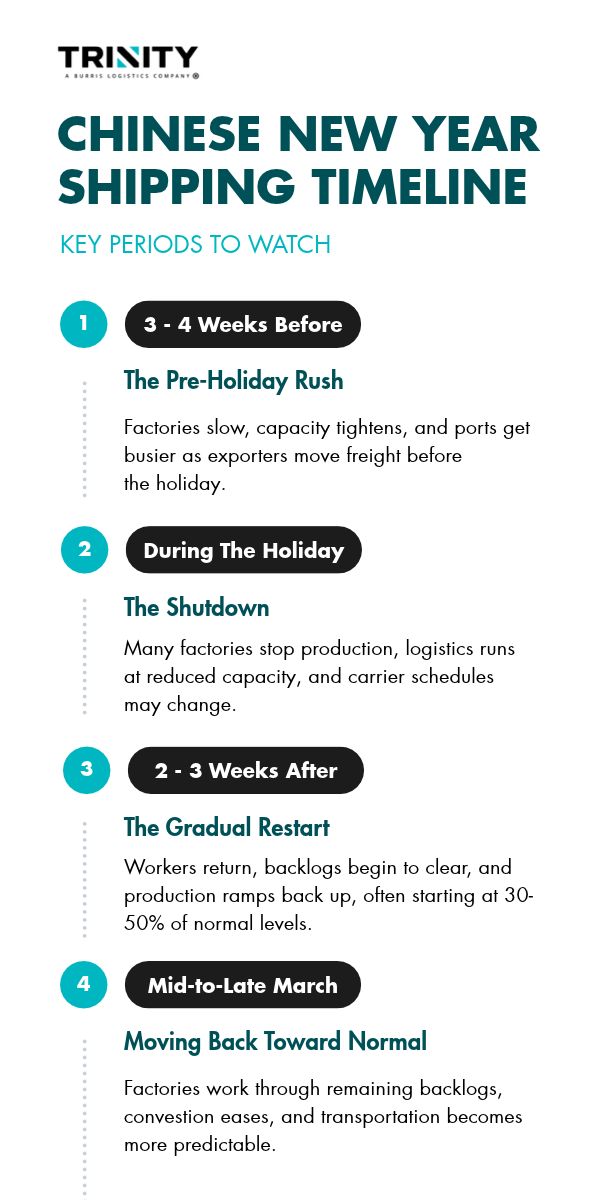
3–4 Weeks Before Chinese New Year: The Pre-Holiday Rush
The holiday, also known as Lunar New Year, starts adding pressure to supply chains well before factories officially close.
3-4 weeks before, factories will start to slow down, and workers may begin traveling home; so schedules get tighter. At the same time, exporters start trying to move as much freight as possible before operations come to a full stop.
That creates competition for ocean capacity. Vessel space becomes harder to secure, ports get busier, and containers may wait longer for space on a sailing. Inland transportation at origin can tighten too, making it more difficult to move freight from factories to ports.
What Transportation Managers Should Watch:
- Cargo-ready dates
- Vessel space
- Port conditions
- Rolled bookings
- Inland transportation capacity
This is also when supplier communication becomes especially important. An unexpected slowdown, or a supplier that suddenly becomes difficult to reach, can be an early warning that your planned timeline is slipping.
During Chinese New Year: The Shutdown
Once the Chinese New Year begins, manufacturing may stop completely at many facilities, while logistics operations run at reduced capacity.
Ocean transportation doesn’t simply continue as usual, either. Carriers may adjust schedules or announce blank sailings in response to changing volumes. That means even if cargo is technically ready, the expected vessel may not be.
Communication can also become limited or nonexistent while suppliers and local partners are away.
If transportation wasn’t arranged ahead of time, your options during this time may be limited.
What Transportation Managers Should Watch:
- Blank sailings and service changes
- In-transit shipments
- Shipment exceptions
- Vessel and arrival schedules
2–3 Weeks After Chinese New Year: The Gradual Restart
Once the holiday celebrations are over, factories don’t flip a switch on and immediately return to full production.
Workers return gradually, suppliers work through backlogs, and production lines ramp up over time. Some factories may initially operate at only a fraction of normal capacity. Industry sourcing guidance commonly describes early restart levels around 30–50% before production builds back toward normal.
At the same time, pent-up demand begins moving through the transportation network. Port congestion can compound existing delays, transit times may run longer, and vessel space can remain difficult to secure.
What Transportation Managers Should Watch:
- Actual supplier production levels
- Production backlogs
- Vessel capacity
- Changing cargo-ready dates
- Port congestion
Don’t assume a supplier’s official reopening date means your order is back in production. Confirm what is actually happening with your freight.
Mid-to-Late March: Moving Back Toward Normal
By mid-to-late March, production and transportation conditions may begin settling toward normal levels, although timing will vary by supplier, lane, and mode.
Factories work through remaining backlogs, congestion begins to ease, and transportation conditions can become more predictable.
What Transportation Managers Should Watch:
- Remaining production backlogs
- Supplier performance
- Transportation conditions
- Inventory recovery
The important word here is “toward.” There isn’t one universal date when the supply chain returns to normal. Plan based on what’s happening with your specific suppliers, lanes, and freight.
Who Is Most Affected by Chinese New Year Disruptions?
Not every shipper faces the same level of risk.
Companies tend to have greater exposure when their supply chains depend heavily on:
- Asian suppliers
- Single-source components
- Just-in-time inventory
- Time-sensitive or seasonal products
- Limited alternate transportation options
- Critical Q1 production or product launches
- Inflexible warehouse or distribution center receiving windows
Industries such as manufacturing, automotive, electronics and semiconductors, retail, food and consumer goods, and apparel can be particularly sensitive to disruptions.
But there’s another risk that can be easy to overlook: your receiving operation.
Your container can arrive at the port exactly when expected and still create problems if your warehouse or DC doesn’t have the appointments, labor, space, or flexibility to receive it.
That’s why Chinese New Year planning shouldn’t stop at the port.
The Drayage Ripple Effect: What Happens When Chinese New Year Freight Reaches North America
For North American shippers, the factory shutdown may be thousands of miles away, but its effects on supply chains aren’t.
To better understand what shippers should expect and how they can prepare for the drayage challenges that come during this critical time of year, we turned to Chad Schilleman, Vice President of Drayage Services at Trinity Logistics, for his insight. The guidance below comes directly from what Chad and his Drayage Team see when helping shippers navigate Chinese New Year.
Expect 2 Waves, Not 1
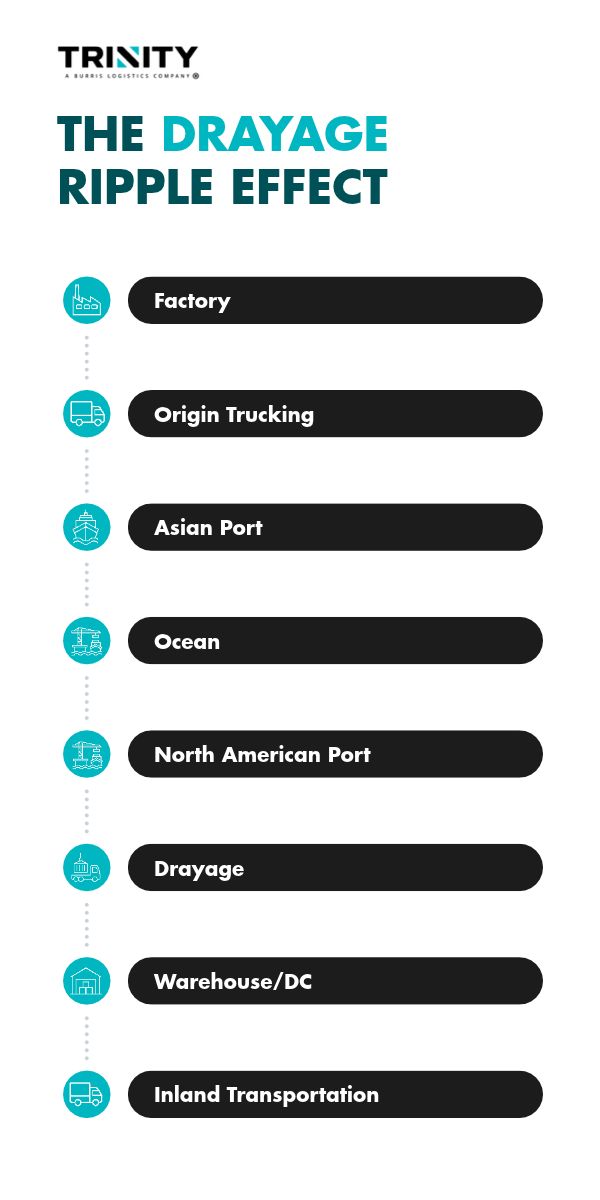
Chinese New Year freight often reaches North America in 2 distinct freight waves.
Wave 1 is a front-loaded surge of imports shipped before factories start to close. Those vessels can arrive in tight clusters.
Next comes the deceptive 2-3-week lull. That’s often where shippers can get comfortable.
Then the post-holiday production catches up, and the second wave begins moving across the ocean. Shippers who relaxed during the lull may suddenly find themselves managing another concentration of container arrivals.
These freight waves can affect:
- Terminal appointment availability
- Chassis and equipment availability
- Container dwell
- Warehouse and DC receiving capacity
- Demurrage and detention exposure
- Inland transportation demand
In most cases, the drayage move itself isn’t the constraint.
Appointment scarcity, chassis availability, container dwell, and receiving capacity at the destination can have a bigger impact on whether freight keeps moving.
What Should Shippers Be Watching?
When we asked Chad what signals he watches as Chinese New Year approaches, his list went beyond simply watching the calendar.
Keep an eye on:
- Vessel schedules and blank sailings
- Terminal appointment availability
- Container dwell and turn times
- Chassis pools
- Supplier communication
That last one can be particularly telling. A supplier going quiet earlier than expected is often one of the first real warning signs that something has changed.
If communication starts slowing down, don’t assume everything is moving according to plan. Confirm production status, cargo-ready dates, and whether your original transportation timeline is still realistic.
Communicate Volumes 60–90 Days Out
For 2027, that means conversations should begin in November and December 2026, not late January.
Give your logistics partner the best information you have, including:
- Supplier shutdown and reopening dates
- Cargo-ready dates by purchase order
- Rough container counts by port of discharge
- Which SKUs are genuinely critical
- Destination receiving hours and flexibility
You don’t need every detail finalized before starting the conversation.
As Schilleman puts it: “An early directional forecast beats a precise late one.”
That early visibility gives your logistics partner more room to plan drayage, sequence deliveries, identify alternate solutions, and prepare for potential bottlenecks.
Don’t Wait Until the Container Lands to Arrange Drayage
If you wait for a container to hit the terminal before making a plan, you may already have fewer options.
When possible, pre-book drayage once the vessel is confirmed. If several containers are expected to arrive together, consider intentionally staggering deliveries instead of sending everything to your facility at once.
And if receiving space could become an issue, identify overflow storage, transload, or yard options before you need them.
The goal isn’t simply to get the container out of the port. It’s to keep the entire move flowing.
Know Your Free Time
Demurrage and detention costs can add up quickly when freight gets stuck, so understanding the difference between the two can help you avoid unnecessary charges.
Demurrage applies while a container sits at the terminal beyond its free time. Detention (per diem) applies when equipment is kept outside the terminal beyond its allotted free days. Pulling a container stops demurrage, but the detention clock continues.
Here’s How to Stay Ahead of Both
- Know your free time. Check the terms for both the terminal and steamship line, as they can differ.
- Consider a pre-pull. If your distribution center isn’t ready to receive a container, moving it to a yard or transload facility can provide a temporary buffer. Pre-pulls and storage come with costs, but they can often be far cheaper than demurrage charges.
- Clear holds before arrival. Make sure customs, freight, and any agency holds are released before the vessel arrives so the container can be pulled as soon as it’s discharged.
- Return empties promptly. This helps limit detention charges, although terminals may restrict empty returns during surges, potentially extending detention even when you’ve planned ahead.
Consider Alternate Routes Before You Need Them
Chinese New Year disruptions aren’t uniform, so treat capacity as a targeted risk rather than a systemwide one. Conditions can vary significantly by origin, destination, lane, and mode.
An alternate port, transportation mode, or routing strategy can give shippers another option, but only if the decision is made early enough.
Once a container is already on the water headed toward a congested port, your options narrow quickly.
That’s another reason to start conversations early. If your logistics partner can see where volume is coming from, where it’s going, and when it will be ready, there’s more opportunity to evaluate alternatives before your freight is committed to a route.
When Should You Book Instead of Wait?
3 conditions should get your attention:
- Your cargo-ready date is within 3 weeks of the shutdown.
- Your volume is heavily concentrated at 1 port.
- You have little or no flexibility at the receiving end.
If any of those describe your freight, don’t wait to secure a plan. Your options may only get narrower as the shutdown approaches.
Have cargo-ready dates or containers already on the way?
That’s enough to start the conversation. Give our Drayage Team an early look at what’s coming so we can help you prepare.
Get a Free Drayage QuoteWhy Chinese New Year Matters Even If You Don’t Import Directly from China
It’s easy to assume Chinese New Year shipping delays only matter to companies directly importing finished products from China.
Modern supply chains don’t work that neatly.
Chinese components and materials feed manufacturing operations throughout North America. In 2025, China still represented about 9% of total U.S. imports, while China accounted for 11.5% of Canadian imports.
Mexico is another important piece of the picture. Mexico imported more than $133 billion in goods from China in 2025, including significant volumes of electronics, machinery, vehicles and parts, and plastics. Research on Mexico’s major export industries also shows meaningful reliance on Chinese inputs in sectors such as vehicles, machinery, and electrical equipment.
That means a production slowdown in Asia can eventually affect manufacturing schedules in Mexico, which can then influence cross-border transportation volumes into the United States.
In other words, you don’t necessarily need a container coming directly from China to feel the ripple effect.
Already Behind? Start Here
Maybe Chinese New Year is only a few weeks away and you’re reading this thinking, “We should have started sooner.”
There may still be options. When a shipper comes to Trinity last-minute and without a plan, Chad says his team’s first question is simple:
What’s already on the water, and what hasn’t shipped yet?
Because those are 2 different problems.
For freight already in transit, focus on the landing side, so your drayage, receiving capacity, delivery sequencing, transload or storage options, documentation, and free time.
For freight that hasn’t shipped, confirm your supplier’s actual shutdown date and have an honest conversation about what can realistically move before the holiday, and what may not arrive until March.
If you’re behind, here’s your best approach:
- Separate what’s on the water from what hasn’t shipped.
- Confirm your supplier’s actual shutdown date.
- Protect your three most critical SKUs.
- Pre-book drayage and overflow storage.
- Check free time by terminal and steamship line.
- Call your logistics partner today.
Some things can still be fixed late, like your drayage scheduling, transload and storage, delivery sequencing, and documentation.
But there are other things that can’t, like production that never happened, vessel space that’s already gone, a blank sailing, or free time that has already expired.
Knowing the difference between the two helps you put your energy where it can still make an impact.
Behind on your Chinese New Year shipping Plan?
There may still be options. Let’s see what’s possible.
Get Help With A Free QuoteChinese New Year Shipping Checklist
Before Chinese New Year
- Confirm supplier closure and reopening dates.
- Identify critical inventory and SKUs.
- Confirm cargo-ready dates.
- Secure necessary freight capacity.
- Finalize shipping documents.
- Coordinate drayage and inland transportation.
- Confirm destination receiving hours and flexibility.
During Chinese New Year
- Monitor in-transit shipments.
- Watch vessel schedules and blank sailings.
- Monitor port and terminal conditions.
- Stay in contact with logistics partners.
After Chinese New Year
- Confirm suppliers have actually resumed production.
- Monitor production backlogs and cargo-ready dates.
- Watch port congestion and vessel capacity.
- Adjust transportation plans as conditions change.
Start Planning Before Chinese New Year Shipping Delays Start
Chinese New Year isn’t a 1-week supply chain event.
The impact begins with the pre-holiday production and shipping rush, continues through factory closures, and carries into the post-holiday recovery. By the time that freight reaches North America, transportation managers may be dealing with concentrated container arrivals, limited appointments, chassis availability, receiving constraints, and inland transportation needs.
The earlier those pieces are connected, the more options you have.
At Trinity Logistics, we help shippers look beyond a single move and coordinate the pieces that keep freight moving, from international transportation and drayage to warehousing and inland transportation.
Whether you’re planning months ahead or looking at containers already on the water, our people are here to help you determine the best next move.
Know what you need to move? Let’s get ahead of it.
Start a conversation with Trinity about your upcoming freight and drayage needs.
Get Started With A Free Quote