11/23/2026 by Christine Morris
Chameleon Carriers Explained: A Growing Threat to Shippers
Freight fraud is always changing. As shippers, brokers, carriers, and regulators strengthen their defenses, bad actors look for new ways around them.
One threat getting more attention across the transportation industry is chameleon carriers. They can be difficult to spot because they can look legitimate on paper. A carrier’s authority may be active, and its profile may not raise any immediate alarms. But behind those credentials could be ties to a company with a history a shipper would want to know about.
That’s what makes this threat so challenging. Identifying a chameleon carrier requires looking beyond what’s on the surface. It’s asking whether the people, equipment, ownership, safety history, and other details tell the same story.
For shippers, knowing what to look for can help keep the wrong carrier from ever leaving the dock with their freight.
Key Takeaways
- Chameleon carriers are trucking companies that hide a problematic safety, compliance, or operating history by operating under a different or seemingly cleaner identity.
- Common chameleon carrier tactics can include VIN sharing, buying established MC numbers, keeping existing contact information, and moving operations among related individuals.
- One unusual detail doesn’t always mean fraud. Carrier vetting should look at the full picture, including authority, safety history, ownership, equipment, business history, and contact information.
- Technology alone isn’t enough to identify chameleon carriers. Strong vetting combines technology, ongoing monitoring, experienced people, and trusted carrier relationships.
- Shippers can help protect their freight through careful carrier selection, shipment tracking, and clear communication with logistics providers before freight leaves the dock.
Meet the Bad Guys: What Are Chameleon Carriers?
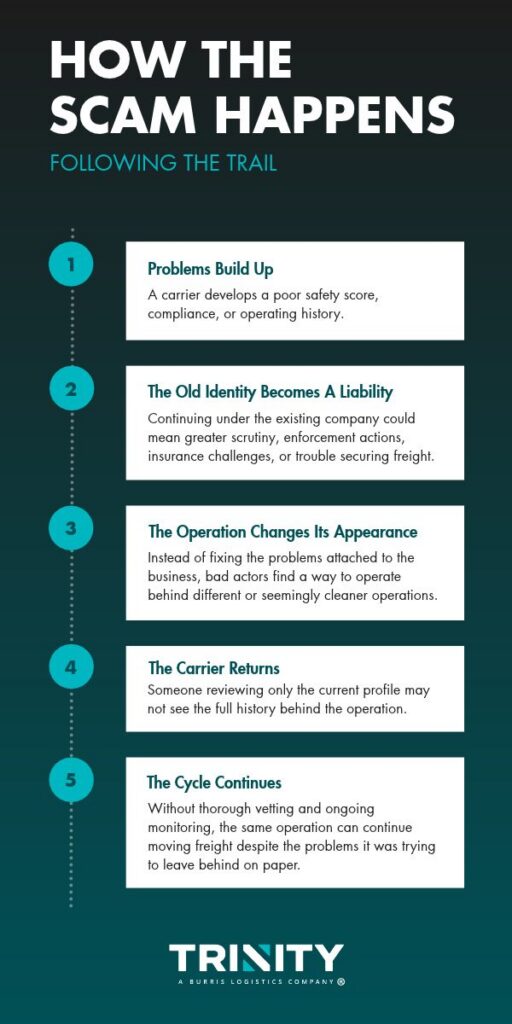
Say a trucking company builds up serious safety violations, faces enforcement action, receives an out-of-service order, or develops another troubling history.
Instead of fixing those problems, the company shuts down. Then, it resurfaces under a different name, ownership structure, or USDOT registration.
That’s a chameleon carrier.
The identity may be different, but much of the operation behind it can stay the same. That could include the trucks, the drivers, the managers, the facilities, or operating practices.
It’s the ultimate motor carrier disguise, appearing to be a new company while trying to leave a bad history behind.
What makes these carriers difficult to spot is that transportation companies often have a lot of moving pieces.
Equipment gets bought and sold. Employees change companies. Businesses move. Ownership changes. New carriers enter the market every day.
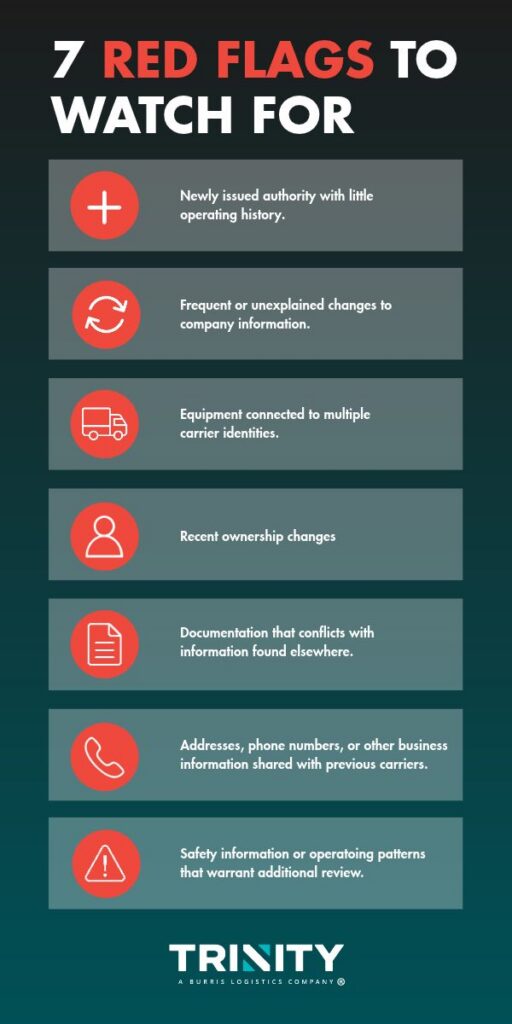
All these things can happen for legitimate reasons, so one unusual detail isn’t automatically a proof of fraud.
The challenge is knowing when several details form a pattern.
Think of carrier vetting today less like checking one credential and more like putting together a 500-piece puzzle. Authority, safety, equipment, ownership, business history, and contact information are individual pieces. You don’t get the full picture until you see how they all fit together.
That’s why experienced vetting matters. A system can verify information, but someone still needs to notice when the information doesn’t quite fit.
Expert Insight: What Trinity Is Seeing from Chameleon Carriers Today
While the basic pattern may seem straightforward, today’s chameleon carriers aren’t as easy to spot as shutting down Company A and opening Company B.
We asked Breanna Bly, Carrier Compliance Manager at Trinity, what the Team is seeing in today’s market and where shippers should pay closer attention.
One Truck, Multiple Identities
One tactic to watch is VIN sharing.
Large, illegal freight networks can operate through numerous related or shell companies. When one is shut down or loses its insurance, the equipment doesn’t always disappear with it. The same trucks and the same Vehicle Identification Numbers (VINs) can be updated or re-registered under another related DOT number.
Trinity’s Team is also seeing cases where the same VIN may appear under several active DOT numbers at the same time. This can allow bad actors to spread their operations across different carrier identities. It may also help them work around a company that has been banned by a broker or hide activity that would otherwise raise concerns.
This makes equipment information another important part of carrier-vetting. If a VIN doesn’t match the carrier’s identity or appears tied to several, it’s worth a closer look.
Buying a Clean History
Not every bad actor starts over with a brand-new authority. Some target well-established carriers with long-standing MC numbers and clean histories.
According to Breanna, bad actors may approach any carrier, even those with no plans to close their business. One tactic Trinity’s Team has seen is offering cash to buy an established MC number with a clean record.
But the tactic doesn’t stop there. Bad actors may also ask the previous owner to keep the same email address and phone number tied to the business. That way, brokers reviewing the carrier’s information may not notice any changes that would normally raise a red flag.
This allows the operation to appear established and trustworthy, even if the people behind it have changed.
It’s an important reminder that consistency isn’t always confirmation. Just because a carrier’s contact information hasn’t changed doesn’t mean the people running the operation are still the same.
Safety History Is Back in the Conversation
Safety scores are moving back to the forefront of carrier vetting conversations.
Breanna points to the recent attention surrounding the C.H. Robinson liability case as one reason for the renewed focus on carrier selection and safety information.
For shippers and logistics providers, this reinforces the importance of looking beyond active authority. Safety history, ownership, equipment, identity, and operating information all contribute to a more complete understanding of who is actually being trusted with the freight.
Breanna states, “You can’t rely on one piece of information anymore. You have to look at the carrier as a whole and make sure everything tells the same story.”
While the tactics for chameleon carriers may change, their objective remains the same – to make an operation appear safer, cleaner, or more established than it really is. Catching those discrepancies takes technology, thorough processes, and experienced people who know when something deserves a second look.
Put an Experienced Team Between Your Freight and Fraud
Carrier fraud is changing fast, and spotting risk takes more than checking whether a carrier has active authority. Trinity Logistics combines thorough carrier vetting, experienced people, trusted carrier relationships, and shipment visibility to help protect your freight from pickup through delivery.
Ready for another layer of protection?
Get Started With A Free QuoteHow Technology Is Strengthening Carrier Verification
As fraud tactics evolve, the systems used to verify carriers are changing, too.
The FMCSA is modernizing its registration process through Motus, its new registration platform. The system is designed to strengthen identity and business checks. These added steps can make it harder for bad actors to hide behind a false or misleading carrier identity.
For the industry, that’s an important step forward.
But stronger technology isn’t a complete solution.
Fraud tactics will continue to change alongside new safeguards. That means strong technology still needs experienced people who recognize when something doesn’t look right and are willing to investigate further.
What Happens if You’re Hit? When the Case Becomes Reality
When the wrong carrier gets through, the consequences can extend far beyond a missed delivery.
A shipper could face freight delays or cargo loss, operational disruption, insurance claims, unexpected costs, and strained customer relationships. If the carrier has hidden an unsafe operating history, the risk extends beyond the freight itself.
There’s also the work that comes after an incident. Teams may need to figure out what happened, find the parties involved, handle claims, communicate with customers, and adjust operations around freight that never arrived as expected.
In other words, the cost of inadequate vetting can be much greater than the time it takes to investigate a carrier before awarding a load.
The industry is taking notice, too.
Efforts such as the Safety and Accountability in Freight Enforcement (SAFE) Act aim to strengthen how chameleon carriers are found before they can reenter the market under another identity. Proposals include improved screening during registration and better coordination to identify connections such as shared ownership and recycled equipment.
Along with Motus, these efforts demonstrate a larger push to making carrier identity more transparent.
For shippers, however, stronger regulations shouldn’t replace internal safeguards. They’re another layer of defense.
How to Protect Your Freight: Strengthen Your Investigation
Protecting freight requires multiple layers, starting before a carrier is ever awarded the load and continuing until delivery.
Establish a thorough carrier-vetting process.
Verify more than active authority. Review available safety information, insurance, ownership, business history, equipment, contact information, and other relevant details before trusting a carrier with freight.
Investigate inconsistencies.
If something doesn’t line up, don’t ignore it because everything else looks acceptable. An unexplained discrepancy may be exactly what warrants additional verification.
Don’t make carrier vetting a one-time event.
Vetting shouldn’t stop after onboarding. Ownership, authority, insurance, safety information, and other carrier details can change. Ongoing monitoring can help transportation teams catch significant changes before the next load is tendered.
Use shipment tracking as another layer of protection.
Once freight is moving, visibility matters. ELD-based tracking, like MacroPoint, and other tracking systems, can help teams monitor a shipment and identify movement that doesn’t match expectations.
Tracking shouldn’t replace carrier vetting, but it can strengthen the security process after a load leaves the facility.
Strengthen communication before freight leaves the dock.
Fraud prevention doesn’t belong to one party. Shippers and their logistics providers should work together to verify the expected carrier and shipment information at pickup.
Shippers and logistics providers each have interactions with the carrier before freight leaves the dock. Whether the driver is changed last minute, a truck with a different carrier name arrives, if something feels off, communicate it before the truck leaves, when there’s still an opportunity to stop something that doesn’t quite add up. Knowing who is expected to arrive, what equipment is expected, and how the shipment will be tracked creates another opportunity to catch something suspicious while the freight is still secure.
Prioritize trusted carrier relationships.
Established carrier relationships create familiarity that can be difficult to replicate through a database alone. Knowing the carriers, people, equipment, and operating patterns behind your freight makes unexpected changes easier to recognize.
The strongest defense combines good information, reliable technology, consistent processes, and people who know when to ask another question.
At Trinity Logistics, carrier relationships and consistent communication are central to how we approach transportation. Technology gives teams more information, but experienced people still must know what to look for, and when to ask another question.
Closing the Case
Chameleon carriers rely on their disguise.
That’s why protecting your freight these days requires looking a little deeper than we’re used to.
Strong carrier vetting means connecting the dots between authority, safety, ownership, equipment, business history, and other available information. It means investigating inconsistencies instead of overlooking them. And once a load is awarded, shipment visibility and clear communication with the shipper help carry that protection beyond the vetting process.
Bad actors will continue looking for ways around the industry’s defenses, but shippers don’t have to make it easy for them.
At Trinity Logistics, we believe protecting freight takes both technology and people. Through our thorough carrier vetting, trusted relationships, shipment visibility, and communication with our shippers, we work to strengthen the security surrounding every load and stay alert as freight fraud continues to evolve.
Know Who’s Moving Your Freight
You shouldn’t have to navigate changing carrier fraud tactics alone. With Trinity Logistics, you gain a transportation partner focused on careful carrier selection, clear communication, shipment visibility, and the relationships that help keep your freight moving securely.
Let’s talk about how Trinity can support your shipping strategy.
Get Started By Requesting A Free Quote