
03/09/2026 by Jared Aubert
Why Freight Claims Expertise Matters More Than You Think
In logistics, few phrases are as feared as “freight claims”.
They slow operations, frustrate customers, strain hard-earned relationships, and pull teams away from the work they should be focused on. Damage, theft, or shortages are never part of the original plan, but they are a reality of moving freight across long distances and multiple touchpoints.
With more than 18 billion tons of freight moved annually in the United States, on average 1-2% of all freight shipments result in a claim, so even that modest percent ends up into millions of dollars’ worth of freight claims each year.
No supply chain is perfect. Freight moves through warehouses, trailers, ports, docks, and countless hands along the way. Issues or complications can happen, even in well-run operations.
What separates a manageable situation from a costly disruption is not whether a claim occurs, but how prepared you are when it does. Cargo claims don’t have to spiral into chaos when they’re handled by experienced professionals who know what to do and how to guide the process forward.
Shippers who work with the right logistics providers are better positioned to navigate freight claims smoothly, confidently, and with far less disruption when, not if, they happen.
As you evaluate a 3PL provider, ask them these two distinct questions regarding claims:
- How many years of experience does your team have handling cargo claims?
- Do you have any Certified Claims Professionals (CCP) on staff?
What Are Freight Claims?
A freight claim is a formal request for reimbursement when goods are lost, damaged, delivered short, or arrive too late to be useful. You may also hear these referred to as cargo claims or transportation claims. Regardless of the term, the purpose is to restore the shipper or consignee financially when a motor carrier fails to meet its obligations under the bill of lading.
Types of Freight Claims
Freight claims can take several forms.
- Loss of product
- Damaged product
- Partial delivery, missing product
- Concealed damage – when freight appears fine at initial delivery but reveals damage later
- Delays – when late delivery causes measurable financial loss
Most freight claims stem from familiar issues. Improper packaging, poor loading practices, unclear labeling, environmental exposure such as temperature changes or moisture, and handling errors are common contributors. While not all these risks can be eliminated, understanding them helps you respond more quickly and effectively when an issue arises.
Why Claims Expertise Matters
On the surface, filing a freight claim can seem straightforward. In practice, it rarely is.
Claims involve strict timelines, specific documentation requirements, and multiple parties involved who all have different responsibilities and priorities. The shipper, consignee, carrier, broker, and insurance provider must all be aligned. Carrier liability rules, bill of lading language, and regulatory standards add more layers of complexity.
From the moment damage is discovered, the outcome of a freight claim depends on asking the right questions and gathering the right information. Experienced claims professionals will understand both sides of the situation: what a carrier is legally required to do to move freight, and what must happen administratively to ensure the claim is filed, tracked, and resolved correctly and efficiently.
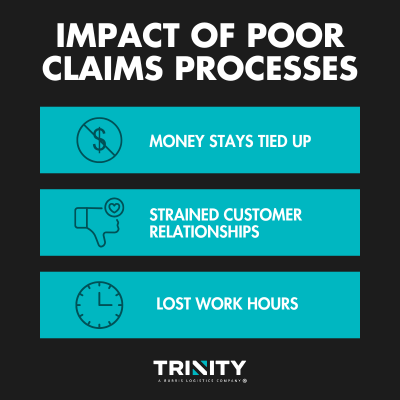
When claims are mishandled, the impact is felt quickly. Money stays tied up longer than necessary. Customers grow frustrated and lose confidence. Internal teams spend hours chasing paperwork and updates instead of focusing on operations. Having dedicated and knowledgeable claims professionals guiding the process shortens timelines, reduces friction, and helps protect the relationships you have worked hard to build.
What Does a Certified Claims Professional (CCP) Do?
A Certified Claims Professional, or CCP, is a credentialled expert trained in freight and cargo claims handling standards and best practices.
In 1980, shipping executives recognized the need for consistent industry-wide standards for claims across transportation modes. This led to the creation of the Certified Claims Professional Accreditation Council (CCPAC), a nonprofit organization dedicated to raising professional competence in freight claims management, and the creation of the CCP credential.
Earning a CCP designation requires documented education and verified work experience in cargo claims. The professional must pass a comprehensive exam covering all transportation modes. Certified professionals must also maintain ongoing education to keep their credentials current.
CCPs excel in their processing of freight claims through:
- Conducting preliminary investigation,
- Identifying correct filing parties and required documentation,
- Navigating carrier liability, insurance standards, and bill of lading language,
- Moving the process forward with fewer delays and missteps,
- and minimizing loss for all parties.
Working with a CCP means that the person handling your claim isn’t guessing. It means confidence. They’re trained, tested, and held to an industry-wide standard of excellence.
Reducing Freight Claims Before They Happen
While freight claims cannot be eliminated entirely, preparation makes a meaningful difference. To reduce your risk of a freight claims, here are some steps you can take:
- Ensure your freight is properly packaged and secured
- Make sure you have clear and thorough documentation of your freight
- Provide clear labeling and handling instructions
- Review insurance coverage and consider adding on shipper’s interested when appropriate
- Be thoughtful and strict in your carrier or partner vetting
- Proactively communicate
Strong preparation doesn’t just lower the likelihood of a claim. It also makes resolution easier and quicker to achieve when something goes wrong, giving you more control in an otherwise unpredictable situation.
Choosing the Right 3PL for Freight Claims Support
Not every third-party logistics provider (3PL) actively manages cargo claims. Some leave shippers or consignees to work directly with carriers, which can be frustrating and time-consuming when issues arise.
If you’re considering a 3PL, it’s worth understanding what level of claims support you will receive. When evaluating a 3PL, it’s good to ask them:
- Do you manage claims-in house?
- How much experience does your team have with claims?
- Do you have any CCP on staff?
- What documentation do you require and how do you help collect it?
- What does the communication cadence look like during a claim?
Claims support should feel like an extension of your business, not a handoff when things get uncomfortable. Asking the right questions upfront helps ensure you have a partner who will stand with you throughout.
Trinity’s Approach to Freight and Cargo Claims
At Trinity Logistics, freight claims are managed by our dedicated in-house Claims Team, with deep experience across logistics and risk management.
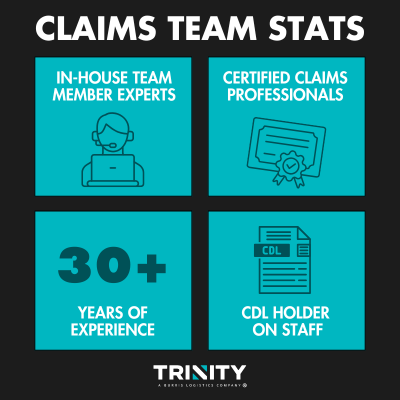
Our Team includes 3 CCPs, with 30+ years of claims experience, 5+ years of logistics experience, and a current Class A CDL holder. This allows us to understand freight claims from every angle and guide shippers through each step with clarity.
Trinity’s Claims Process Step-by-Step
1. Claim intake and initial fact gathering
2. Documentation checklist provided
3. Investigation and loss mitigation guidance
4. Filing with correct party and timeline management
5. Communication cadence
6. Negotiation and resolution
7. Final documentation, recovery, and closure
What Trinity’s Claims Management Means for Your Business
When you partner with Trinity, the benefits go far beyond recovering dollars.
We handle all claims paperwork, documentation requests, carrier communications, and negotiations on your behalf, so your team isn’t pulled into the weeds. That support leads to faster resolutions and better outcomes, while reducing the operational burden on your organization.
Instead of coordinating between all parties involved, you have a single point of contact. That clarity saves time, reduces stress, and keeps everyone aligned.
Just as important, our claims management helps mitigate risk and minimize losses while protecting relationships. Our clear communication, realistic expectations, and professional follow-through help preserve the trust you already have.
What Trinity’s Freight Claims Management Means for Your Business
- One point of contact
- Handled by experienced professionals
- Faster resolutions, better outcomes
- Reduced operational burden
- Mitigated risk, minimized losses
- Relationships protected
- Support through the whole claims process
Freight Claims Happen, But It Doesn’t Have to Be Chaos
Logistics disruptions are part of moving freight. Poor claims handling doesn’t have to be.
With experienced professionals, clear processes, and certified expertise, freight and cargo claims can be manageable instead of overwhelming – and the right partner makes the difference.
At Trinity, you are never navigating claims alone. When something happens, we’re here to help you move forward with clarity, confidence, and full support.
I’M READY TO HAVE THE LOGISTICS SUPPORT I NEED