
09/24/2026 by Christine Morris
8 Manufacturing KPIs Transportation Managers Can Help Improve
When a manufacturing KPI starts moving in the wrong direction, transportation may not be the first place operations leaders look. Sometimes, it should be.
A late inbound shipment can leave production waiting for materials. Inconsistent transit times can lead to excess safety stock. Missed outbound deliveries can hurt customer service metrics. And when teams turn to expedited freight to recover from disruptions, transportation problems can quickly become manufacturing cost problems.
Transportation connects suppliers, production, and customers. Because of that, transportation performance can influence manufacturing KPIs ranging from on-time delivery and cost per unit to production schedule attainment and Overall Equipment Effectiveness (OEE).
Understanding those connections can help uncover where freight is creating operational risk and where a stronger transportation strategy could make a measurable difference.
Key Takeaways
- Transportation can affect manufacturing KPIs from inbound material availability through final customer delivery.
- Rising expedite costs, late materials, unreliable transit times, and missed deliveries can point to transportation problems.
- Tracking freight performance alongside manufacturing KPIs can reveal costs and risks that freight spend alone may miss.
- Trinity customer MW Supply saw a 59% decline in damaged freight after partnering with Trinity for its transportation needs.
5 Signs Transportation May Be Hurting Manufacturing Performance
Not every manufacturing problem is a transportation problem. But certain patterns should encourage transportation managers to look deeper.
1. Expedite spend keeps increasing
Occasional expedites happen. But if expedite spend keeps climbing, look for recurring problems with inbound service, capacity, or planning.
2. Production frequently waits on materials
If critical materials often arrive after they’re needed, look at the full inbound journey. Check supplier readiness, pickup performance, transit time, and final plant delivery.
3. You’re carrying extra inventory because transportation isn’t predictable
Safety stock protects production. But if you carry extra inventory because inbound delivery times are unreliable, transportation may be part of the problem.
4. The same suppliers, carriers, or lanes repeatedly cause problems
Patterns matter. Measuring transportation performance at the carrier, lane, and supplier level can reveal recurring issues that network-wide averages hide.
5. Production finishes on time, but customers still receive orders late
If manufacturing hits its schedule, but customer deliveries still miss the mark, outbound transportation may need attention.
Seeing one of these signs doesn’t mean you need to rebuild your transportation strategy. But if several keep showing up, it may be time to find the root cause.
Seeing These Signs in Your Transportation Operation?
Trinity Logistics can help with both immediate freight needs and larger transportation challenges.
Need capacity for an upcoming shipment?
Request a Shipping QuoteDealing with recurring carrier issues, limited visibility, or a transportation team stretched thin?
Explore Trinity's Managed Transportation SolutionsSee it in action: CFM Distributors turned to Trinity when managing carriers and freight became too time-consuming. With Managed Transportation, TMS access, and dedicated support, CFM simplified its processes and reduced transportation costs.
View the CFM Distributors Case StudyTransportation Is Part of the Manufacturing Lifecycle
Transportation doesn’t begin when finished goods leave the plant. It connects the entire manufacturing cycle.
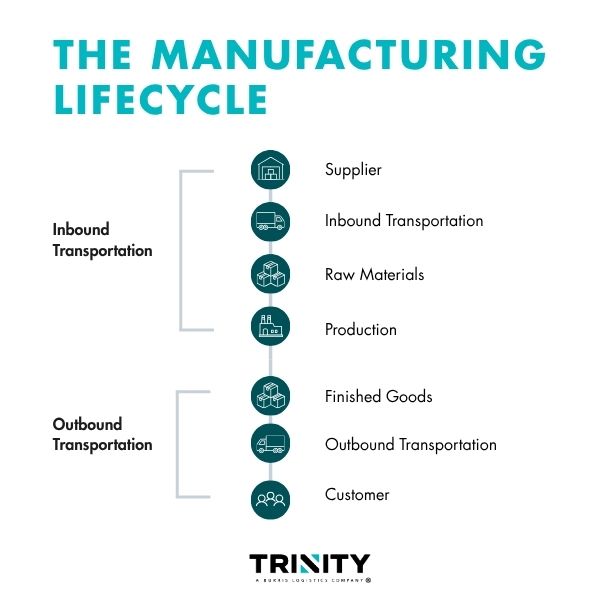
When one part of that flow breaks down, the effects can spread. A late inbound shipment can cause a material shortage, delay production, trigger an expedited need, and put a customer delivery at risk.
That’s why transportation managers should measure more than just freight movement. They should also understand how freight performance affects the wider operation.
8 Manufacturing KPIs and the Transportation Metrics to Watch
| Manufacturing KPI | Transportation Impact | Metrics to Watch |
|---|---|---|
| On-Time Delivery | Outbound service affects customer delivery. | On-time delivery, transit-time variability, service failures |
| Inventory Turnover | Unreliable inbound transit can increase safety stock. | Inbound lead-time variability, inbound on-time delivery |
| Production Cycle Time | Late materials can delay production. | Inbound on-time delivery, late critical shipments, transit variance |
| Cost Per Unit | Expedites and service failures add cost. | Freight cost per unit, expedite spend, accessorial costs |
| Perfect Order Rate | Transportation affects on-time, damage-free delivery. | On-time delivery, freight claims, delivery exceptions |
| Supplier On-Time Performance | Pickup and transit affect plant arrival. | On-time pickup, on-time delivery supplier and lane |
| Production Schedule Attainment | Late materials can disrupt the schedule. | Material-related delays, inbound on-time delivery, expedites |
| Overall Equipment Effectiveness | Material shortages can cause downtime. | Freight-related downtime, critical-material availability |
1. On-Time Delivery
On-time delivery measures whether customer orders arrive when promised. Production can finish on schedule and the order can still be late if transportation falls behind.
How Transportation Can Affect It
Carrier performance, capacity, transit times, and shipment visibility all affect customer delivery. Transportation managers can reduce risk by tracking problem lanes and acting on shipments before a delay becomes a missed commitment.
Transportation Metrics to Watch
- Carrier on-time delivery by lane
- Transit-time variability
- Tender acceptance
- Late-delivery frequency
- Shipments requiring recovery or expedited service
If production finishes on time but customers still receive orders late, transportation may need attention.
2. Inventory Turnover
Inventory turnover measures how well inventory is used and replaced. Too much inventory ties up cash and space. Too little can leave production without the materials it needs.
Transportation doesn’t control inventory turnover on its own. But reliable inbound service can affect how much inventory a manufacturer feels it needs to carry.
How Transportation Can Affect It
When inbound lead times are steady, teams can plan replenishment with more confidence.
When transit times vary, manufacturers may carry more safety stock to protect production.
Transportation Metrics to Watch
- Inbound on-time delivery
- Supplier-to-plant transit times
- Lead-time variability
- Frequency of late inbound shipments
- Transportation-related stockouts
If inventory keeps growing because teams don’t trust inbound delivery times, transportation may be part of the reason.
3. Production Cycle Time
Production cycle time measures how long it takes to turn raw materials into finished products. But production doesn’t begin when the machine starts. It begins when the materials arrive.
How Transportation Can Affect It
Late components or raw materials can delay a production run or interrupt work already in progress.
The risk can be greater for manufacturers that carry less inventory or rely on just-in-time delivery.
Transportation managers can help by identifying critical freight, matching inbound deliveries to production needs, and creating backup plans for high-risk shipments.
Transportation Metrics to Watch
- Inbound on-time delivery
- Late production-critical shipments
- Supplier-to-plant transit variance
- Emergency inbound shipments
- Material shortages connected to late freight
One useful question to ask:
How many production delays during the last quarter involved a material that did not arrive when expected?
That answer can show how closely freight and production performance are linked.
4. Cost Per Unit
Cost per unit reflects the total cost of producing a product. Manufacturing efficiency is a major driver, but transportation problems can add costs, too.
How Transportation Can Affect It
Consider what happens when a critical inbound shipment is late.
The manufacturer may pay for expedited transportation to get replacement materials to the plant. Production may slow or stop. Another shipment may then need to move faster to protect the customer’s delivery date.
One transportation disruption can create costs in several places.
Transportation Metrics to Watch
- Freight cost per unit
- Expedite spend
- Accessorial charges
- Cost of transportation service failures
- Frequency of emergency shipments
Rising expedited spend is particularly worth investigating. Some expedites are unavoidable. But frequent emergency freight may point to problems with planning, capacity, carrier performance, or inbound service.
Manufacturing Example: Finding Costs Beyond the Freight Rate
Hill & Smith wanted better freight visibility and lower costs without giving up service. After partnering with Trinity, the company streamlined LTL and truckload shipping and reported lower shipping costs, accessorial fees, and reclassification charges.
Read the Hill & Smith Case Study5. Perfect Order Rate
Perfect Order Rate measures how often customers receive the right order, in the right amount, on time, and without damage.
Transportation doesn’t control every part of a perfect order. Product and quantity accuracy often depend on production and warehouse processes.
But once freight is moving, transportation plays an important role.
How Transportation Can Affect It
Carrier handling, transit performance, delivery reliability, and exception management can affect whether an order arrives on time and without damage.
Transportation Metrics to Watch
- On-time delivery
- Freight claims
- Damage frequency
- Delivery exceptions
- Transit-time performance
Looking at why an order failed can help show whether the problem started in manufacturing, fulfillment, or transportation.
Manufacturing Example: Reducing Freight Damage
After centralizing freight management with Trinity Logistics, MW Supply gained better shipment visibility and saw a 59% decline in freight damaged. Trinity now handles the company’s inbound, outbound, and drayage shipments.
Read the MW Supply Case Study6. Supplier On-Time Performance
A supplier can have an order ready on time and the material can still arrive late.
That’s why a late inbound shipment doesn’t always mean the supplier is the problem.
How Transportation Can Affect It
There are several points where an inbound order can fall behind:
Separating those stages helps manufacturers find the real source of the delay.
If freight is ready but pickups are late, transportation may be the issue. If pickups happen on time but deliveries vary, carrier or lane performance may need a closer look.
Transportation Metrics to Watch
- Supplier ready date
- On-time pickup
- On-time delivery
- Transit-time variability
Better visibility can also lead to more productive conversations with suppliers. Instead of treating every late arrival as a supplier failure, teams can see where the delay really happened.
7. Production Schedule Attainment
Production schedule attainment measures how closely actual production matches the plan.
Transportation becomes part of that conversation when the production plan depends on materials that haven’t arrived.
How Transportation Can Affect It
Late inbound freight can leave production teams without critical parts or components. That can lead to schedule changes, idle time, added labor costs, or delays that affect customer commitments.
Transportation managers can reduce risk by matching inbound freight to production needs, watching critical lanes, and creating backup plans before problems occur.
Transportation Metric to Watch
- Inbound on-time delivery
- Number of late production-critical shipments
- Production delays associated with missing materials
- Expedite frequency
- Carrier performance on critical lanes
One useful question may not be on your transportation dashboard today:
What percentage of production schedule misses involved a late inbound shipment?
Connecting freight and production data can reveal problems that are easy to miss when each team tracks performance on its own.
8. Overall Equipment Effectiveness (OEE)
Overall Equipment Effectiveness measures equipment availability, performance, and quality.
Transportation doesn’t directly control OEE, but it can contribute to one important component – availability.
How Transportation Can Affect It
Equipment can’t make the planned product if the needed materials aren’t there.
If a late shipment causes a material shortage and a line sits idle, that downtime can affect equipment availability.
The goal isn’t to claim transportation “improves OEE.” The goal is to reduce the chance that unreliable freight becomes one reason equipment isn’t producing.
Transportation Metrics to Watch
- Freight-related production downtime
- Critical-material availability
- Late production-critical shipments
- Inbound on-time delivery
- Emergency freight associated with material shortages
Transportation managers should focus on the part of OEE they can influence and work to reduce freight-related downtime.
1 Late Shipment Can Affect More Than 1 Manufacturing KPI
Manufacturing KPIs don’t operate independently. Neither does transportation.
A single late shipment can create a chain reaction:
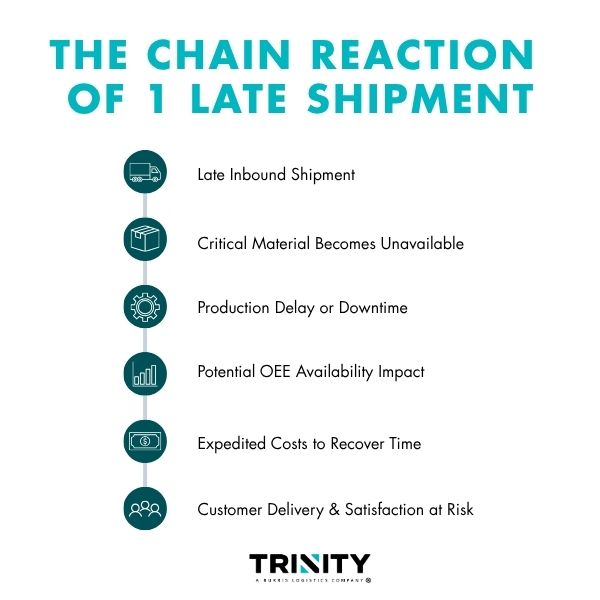
That’s why looking at freight costs alone can leave part of the story hidden.
A low-cost shipment can become expensive if poor service leads to extra inventory, production downtime, expedites, or a late customer delivery.
Transportation managers can create more value when they connect freight decisions to their impact on the wider operation.
Manufacturing Trends Can Also Affect Transportation
The relationship between manufacturing and transportation works both ways.
Transportation performance can influence manufacturing KPIs. Changes in production can also affect future freight needs.
When production grows, manufacturers often need more inbound materials and more outbound capacity. When production slows, freight demand may soften.
When manufacturing activity slows, transportation volumes can soften as companies require fewer materials and have fewer finished goods to ship.
That’s why transportation managers shouldn’t only look at yesterday’s freight metrics when planning for tomorrow. They should look at production forecasts, inventory plans, customer orders, and broader manufacturing trends to prepare for changes in freight demand and capacity.
Planning ahead can help teams respond before transportation needs shift.
How Trinity Logistics Helps Manufacturers
Manufacturing freight rarely goes exactly as planned. Production schedules change. Suppliers run late. Capacity tightens. Customer needs shift.
Having the right transportation partner means having someone who understands both the shipment and what’s at stake behind it.
At Trinity Logistics, we work with manufacturers to build transportation solutions around their operational needs. Our logistics experts can help manufacturers strengthen carrier coverage, gain better visibility into shipments, plan for changing capacity needs, navigate disruptions, and keep freight moving when plans change.
That can mean helping address challenges such as:
- Inconsistent inbound transportation
- Recurring capacity issues
- Rising expedited freight needs
- Unreliable carrier performance
- Limited shipment visibility
- Changing production and shipping requirements
- Outbound delivery challenges
Our goal isn’t simply to move a load from point A to point B. It’s to provide dependable, transparent support and transportation solutions that help keep your operation moving.
Could Transportation Be Affecting Your Manufacturing Performance?
If you’re seeing late inbound materials, rising expedited costs, unreliable carrier performance, production delays tied to missing materials, or missed customer deliveries, your transportation strategy may deserve a closer look.
Trinity Logistics can help you find the right transportation solution for your manufacturing operation.
Ready to talk about your freight needs?
Tell us what you’re shipping, where it’s going, and what your operation needs. A Trinity Logistics expert can help you explore your transportation options.
Request a Manufacturing Shipping Quote