

10/08/2025 by James Beveridge
Avoiding Freight Fraud: A No-Nonsense Guide for Carriers
Freight Fraud Isn’t a Maybe—It’s a Guarantee If You’re Not Watching
One too-good-to-be-true rate. One rushed booking. One click on the wrong email. That’s all it takes to get caught up in double-brokering, cargo theft, identity scams, or worse.
Owner-operator or fleet boss—doesn’t matter. If you’re in the game, you’re a target. And scammers are banking on you being too tired, too busy, or too tempted by that high rate to slow down and vet them.
But here’s the thing: your time, money, and rep are worth protecting. So let’s talk about how you do that—without slowing your hustle.
Freight Fraud Isn’t Just Annoying—It’s Expensive
You’re not just risking a headache. You’re looking at unpaid loads, blacklisted MCs, frozen payments, and factoring companies pulling the plug. Get scammed once, and suddenly your name’s red-flagged everywhere from boards to back offices.
This isn’t a “whoops” moment. It’s thousands of dollars lost, trust gone, and partnerships torched.
Most Scams Are Simple—That’s Why They Work
Scammers don’t need high-tech tricks—they just bank on you being in a rush or chasing that fat rate. You’ve seen the play: urgent high-paying load, pressure to move fast, shady Gmail address, paperwork that’s “close enough,” and a stolen or baby-fresh MC number.
They’re not slick—they’re betting you won’t stop to check.
Classic Scam Playbook: Know It, Spot It, Dodge It
- “Hot load” with a sky-high rate
- Tells you to skip onboarding—ASAP
- Brand new or borrowed MC number
- Docs that look like they were made in Microsoft Paint
- Gmail, Yahoo, or anything but a legit company email
- Phone number goes straight to voicemail… or nowhere
- Pays in unusual methods, such as with Zelle or Venmo
They’re counting on you being too busy to double-check. Don’t ask questions, and they win. Simple as that.
Classic Trucking Scam Playbook
- Too-good-to-be-true rate on an “urgent” load
- Pressure you to skip onboarding
- Uses a brand-new or stolen MC number
- Documents slightly off (fake)
- Uses Gmail or generic emails instead of company domain
- Lists disconnected or fake phone numbers
The Real Cost of Taking the Bait
Think that crazy-good rate is worth skipping your usual checks?
Here’s what that “shortcut” really gets you:
- A $3,000 load that pays $0
- Shippers slamming the door on your MC
- Invoices your factoring company won’t touch
- Months untangling identity theft hell
- Years rebuilding trust you lost in seconds
Fraud doesn’t just steal your cash. It tanks your whole business.
Outsmart Freight Fraud: Your Non-Negotiable Checklist
Beating fraud isn’t rocket science—it’s discipline. You just need a vetting process and the backbone to stick to it. Every load. Every time.
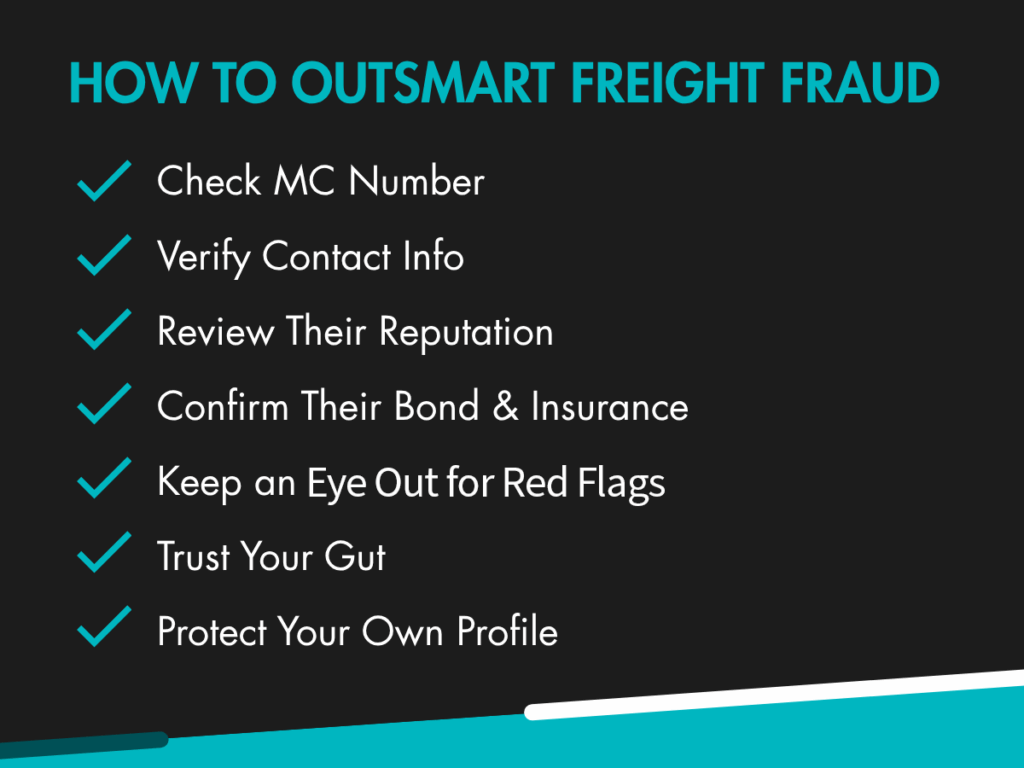
Checklist:
✅ Check the MC number
✅ Verify contact info
✅ Review their rep
✅ Confirm bond & insurance
✅ Hunt for red flags
✅ Trust your gut
✅ Lock down your own profile
Check the MC Number
Start with the FMCSA SAFER system—it’s free, fast, and your first line of defense.
Is the MC number active and authorized? Does it have any operating history?
A brand-new MC doesn’t always scream scam—but it should make you slow down and dig deeper.
Verify Contact Info
Check their email. A mismatched or generic domain like @gmail.com isn’t an automatic red flag—but it should raise an eyebrow. Most established brokers use company domains. If it doesn’t match, dig deeper.
Look at their website. Does it look like a real business or something thrown together in an afternoon?
Verify the phone number. Cross-check it with FMCSA and their site. Better yet—call it. A legit broker won’t mind picking up the phone to confirm things.
Review Their Reputation
Highway is a solid tool for vetting broker profiles—it flags risky behavior fast. And don’t sleep on your network. Carriers talk, and they remember who ghosted them or didn’t pay.
Your factoring company’s another filter. They’ve got visibility into broker payment habits and risk ratings. Before you move that first load, run it past them.
Scammers leave a trail. If something feels smoky, there’s probably fire.
Confirm Their Bond & Insurance
This is where scammers start to sweat.
Always ask for proof of their surety bond and insurance. Then take it a step further and verify it through FMCSA or their insurance provider. Screenshots can be faked in seconds.
Look for:
- Active bond status
- Valid cargo/liability coverage
- Matching MC and company name on all docs
If they dodge the topic or get defensive? That’s your cue to walk.
Watch for Red Flags
Scammers hide in the details. Here’s what to flag:
- Multiple business names that don’t add up
- Addresses that change from doc to doc
- Inconsistent emails, phone numbers, or contact info
If their story doesn’t line up, it’s not a mistake—it’s a setup.
Trust Your Gut
Pressure to move fast. Dodgy answers. Something just feels wrong.
Don’t overthink it—walk away. In trucking, your gut is often smarter than your inbox.
Lock Down Your Own Profile
Fraud prevention isn’t just about others—it’s about protecting yourself too.
- Keep your MC info updated
- Use strong passwords + two-factor authentication
- Watch for phishing attempts
- Stay educated on new scam tactics
The more alert you are, the less likely you’ll be the next target.
Got Scammed? Here’s How You Hit Back
Don’t freeze. Don’t stay quiet. Here’s your playbook:
- Stop all current and future loads with the scammer
- Report them on every load board they touched
- If they spoofed a real company, notify that company
- File with FMCSA’s National Consumer Complaint Database (attach all comms and docs)
- Alert your factoring company—especially if money moved
- Contact your insurance if freight was affected
- Monitor your MC activity for fraud
- Change all passwords
- Warn your network so others don’t fall for it
Fraudsters thrive in silence. Make noise. Shut them down.
What To Do If You Get Scammed
- Cancel all loads booked with fraudulent company
- Report them on load boards
- If posed as legit company, notify them
- File with FMCSA National Consumer Complaint Database
- Alert factoring company
- Notify insurance provider
- Keep eye on MC activity
- Update all passwords
- Spread the word
Your Best Defense? Real Relationships
Good brokers don’t ghost. They pay on time, pick up the phone, and want you hauling with them again next week.
Every time you chase a random high rate from a stranger, you’re gambling. And scams love desperate gamblers.
Stick with brokers who’ve earned your trust. That’s how you stay moving—and stay protected.
Final Word: This Is Your Business. Protect It.
You’re not just hauling freight—you’re running a business. Whether it’s just you or a full fleet, your MC is your livelihood.
Protecting it means doing the work up front. Have a process. Stick to it. Spend the extra five minutes now to avoid five weeks of chaos later.
Ask the hard questions. Use your tools. Trust, but verify.
It’s your freight. Guard it like it pays your mortgage—because it does.
Want to verify a Trinity load?
Scammers use our name too.
Check NowBecause trust isn’t given. It’s earned.
ABOUT THE AUTHOR

James Beveridge
Pricing and Procurement Specialist
James Beveridge doesn’t just work in freight—he breaks it down and builds it back smarter. With 5+ years at Trinity Logistics, he’s worked across Carrier Sales, Compliance, and now Pricing and Procurement, bringing a full-circle view of the supply chain.
He knows carriers aren’t just part of the equation—they are the equation and treating them like customers is how the whole chain wins. James thrives where routing guides break, capacity dries up, and business-as-usual falls short. His specialty? Practical, creative solutions that make it easier to get freight covered—and keep carriers coming back.
For him, logistics isn’t just about moving freight. It’s about moving the needle, together.