05/19/2026 by Christine Morris
Why Most Transportation Management Providers Disappoint
Transportation management plays a larger role in your business success than most people expect.
On the surface, things can look fine because orders move, customers get what they need, and everything looks to be on track.
But when your business starts growing, things begin to shift. While it looks like everything is working as it should, you may notice leadership often starts to feel uneasy. Freight decisions feel fragmented, reactive, and take longer. And it seems like issues start to surface more often than they should.
That’s because growth increases the complexity of your logistics operations. As business scales, your transportation management stops being just an operational function and something that quietly demands more attention, time, and involvement than was previously required by your team.
When most companies hit this stage, they often respond by looking for better tools, but the real issue usually isn’t the tools you’re using. It’s the model behind it.
Why Managing Transportation Feels More Difficult as You Grow
As your business starts to scale, your freight volumes increase, operations expand, and decision-making tends to spread across teams and locations, becoming decentralized. Visibility often fragments, too, so it gets harder to see how everything connects altogether.
Costs start getting accepted rather than actively managed, and while data exists, it doesn’t always lead to clear decisions. Before long, leaders find themselves pulled into operational issues they shouldn’t have to solve.
It doesn’t happen all at once. It breaks down slowly, over time, and that’s what makes it so easy to overlook.
The Hidden Costs of Choosing the Wrong Transportation Model
Most companies evaluate transportation management solutions based on freight cost, but the real impact shows up elsewhere.
Rather than cost savings, what you should be focusing on is cost avoidance. For example, when a customer order takes longer to deliver than expected, or when your team is spending hours solving issues that could have been prevented. It shows up in inconsistent service experiences and distracted leadership.
These examples may not always appear on a report, but they affect your performance every day.
Because your biggest financial risk isn’t overspending. It’s not knowing what inefficiencies are quietly limiting your business growth and long-term success.
The 3 Most Common Transportation Management Approaches (And Why They Don’t Work)
When companies try to improve transportation management, they typically rely on one of these 3 approaches:
In-House Transportation Management
| PROS | CONS |
| Familiarity Sense of control Decisions stay internal | Doesn’t scale well More dependent on individual knowledge and effort Information can stay siloed Scaling requires adding more pressure to your team |
This approach offers familiarity and a sense of control. Your team understands your business, and decisions stay internal.
But as operations grow, the model becomes more dependent on individual knowledge and effort. Processes can vary; information can stay siloed, and scaling often requires adding more pressure to your team.
Technology-Only (TMS First)
| PROS | CONS |
| Visibility Automation | Adoption can be slow Added IT burden Can end up adding complexity |
This approach focuses on gaining visibility and automation through a transportation management system (TMS).
The challenge is that software alone doesn’t run your transportation operation.
Without clear ownership and structured processes behind it, adoption is slow, and teams begin working around the system. What was intended to simplify operations can end up adding complexity and added IT burden.
Fragmented Outsourcing Using Multiple Providers
| PROS | CONS |
| Flexibility | Siloed visibility Inconsistent service Poor accountability Decentralized decisions |
This approach offers flexibility by using multiple providers across lanes and modes.
Over time, however, flexibility can lead to inconsistency. Visibility becomes fragmented, decisions become decentralized, and accountability becomes harder to define.
These Approaches Force Tradeoffs
Each of these approaches addresses part of the problem, but none of them solve it entirely.
As a result, companies often feel like they have to choose between priorities that should work together. They gain scale but lose consistency or improve visibility but add operational burden.
That’s not an effective long-term transportation management strategy. It’s just a series of compromises. And unfortunately, most providers are built around those same limitations, forcing you into tradeoffs.
What an Optimal Transportation Management Model Should Look Like
Companies that manage transportation well take a different approach. Instead of focusing on individual tools or providers, they focus on how the operation runs as a whole.
They use a model where execution is owned, decisions are structured, and visibility leads to action. One accountable model built for scalability, not just activity. And no tradeoffs.
The 3 Elements That Make Trinity’s Managed Transportation Model Work
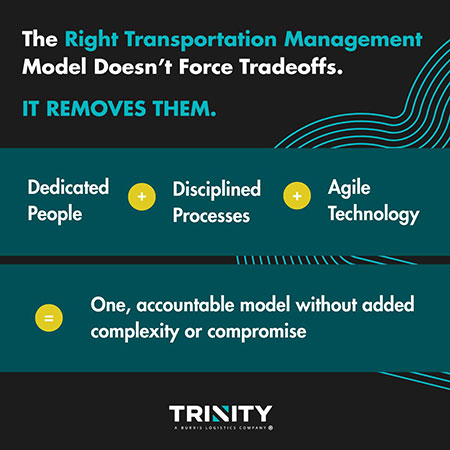
At the center of Trinity’s model are 3 main elements working together.
People
A dedicated Team of experts that manages execution day to day, oversees carrier performance, capacity, and exceptions, addressing any issues before they escalate.
+
Process
A consistent framework offering governance for effective decision-making, with clear workflows and accountability that bring structure to the operation. You gain visibility that actually leads to impactful action.
+
Technology
Tools that enable and support visibility, automation, and insight, without creating additional complexity or burden for your team.
=
A Model Without Tradeoffs
On their own, each of these helps. But when they work together, transportation management becomes far more effective and scalable.
How to Evaluate a Potential Transportation Management Provider
If you’re evaluating transportation management providers, the most important questions aren’t about features. They’re about how your operation will function.
Consider asking:
- Who owns execution in the day-to-day?
- How are decisions made and managed?
- What happens as business grows and complexity increases? Can the model scale?
- How is performance measured and improved over time?
- How much responsibility stays with your team?
The answers to these questions will tell you whether a provider is offering a tool or a wholistic operating model.
What Transportation Management Success Can Look Like
When the transportation management model is right, the difference is noticeable.
Your logistics operations become more predictable, and visibility becomes something you trust rather than question. Decisions are proactive and able to be made earlier, before small issues turn into larger problems. Growth begins to feel more manageable and less risky.
When your transportation management works well, logistics stops being a constant concern to leadership and starts supporting the bigger picture. Your business gets its confidence back because there are no more limitations inflicted by your logistics.
Choose the Transportation Management Model That Works for You – Not Against You
At some point, every company reaches the same realization – that it’s not down to the transportation management system to use and software alone won’t fix structural inefficiencies.
Instead, it’s about how transportation will be managed moving forward. And if your current (or potential) approach forces tradeoffs, then it’s not built for long-term performance.
That’s why Trinity’s Managed Transportation model was designed to remove those compromises by combining experienced people, disciplined processes, and enabling technology into one accountable operation.
The Result?
- Measurable business outcomes you can trust
- A single source of truth
- The ability to avoid unnecessary costs
- Able to actively manage carrier performance, mode selection, routing guides, and network strategy – every day
- Protection from market volatility
- Fewer costly errors and disputes
- Smarter use of total shipping volume
- Improved margins through operational efficiency
- The ability to protect and improve profitability
- A more reliable customer experience
When transportation runs the way it should, it becomes a competitive advantage rather than a constant challenge.
Quantify the True Cost of Your Logistics Operations
If you’re not sure how your operations are performing beneath the surface, the first place to start is with a closer look at your data. It can reveal how decisions are being made, where inefficiencies exist, and what opportunities you may be missing.
From there, you can decide what needs to change.
If you’re ready to take that step, you can request a free supply chain analysis from Trinity Logistics and see what a better transportation management model could look like for your business.
I WANT A FREE LOOK INTO HOW MY SUPPLY CHAIN IS RUNNING