02/02/2026 by Christine Morris
Nearshoring’s Comeback = Stronger Supply Chains
Onshoring, nearshoring, and reshoring are becoming more than industry buzzwords.
Many companies are turning to these strategies to make their supply chains stronger and more stable.
Even before the COVID-19 pandemic, many businesses were already questioning their overseas operations. Labor costs were rising, quality problems were growing, and supply chains were often disrupted. 2020 just revealed how fragile long-distance production became.
Since 2023, businesses have announced over $500 billion in new U.S. manufacturing plans, showing a major move back to producing goods at home. Nearshoring in Mexico and other nearby regions is growing too, thanks to lower costs, helpful trade deals, and being closer to U.S. buyers.
The past few years have proved something simple: the farther the supply chain, the bigger the risk. Bringing production closer to home brings peace of mind.
500+ billion in new U.S. manufacturing investments have been announced since 2023.
-NAIOP
Why are Onshoring and Nearshoring growing in 2026?
A BRIEF LOOK BACK
Before the 1980s, U.S manufacturing was booming. American factories powered local economies and supplied much of the world’s goods.
Then came globalization. It offered improved technology, faster communication, and cheaper labor through offshoring. Many companies moved production abroad to save money and boost margins. And for decades, it worked. Offshoring became the go-to strategy for cost efficiency and global reach.
However, recent disruptions have changed that story. The COVID-19 pandemic revealed just how vulnerable those supply chains could be. Shutdowns and slow shipments left many struggling to keep up. It became clear that when your suppliers are an ocean away, a small problem can quickly turn into a big one.
Today, a new era is emerging. Onshoring and nearshoring are once again gaining momentum as businesses look for more control and supply chains they can count on.
WHAT DO THESE TERMS MEAN? ONSHORING? NEARSHORING? RESHORING?
These terms are often mixed together, but each one plays a unique role in bringing production closer to home.
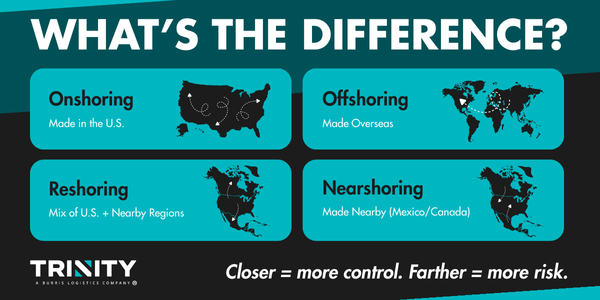
Onshoring refers to bringing production and sourcing back to U.S. soil.
It improves quality control, communication, and delivery times while supporting American manufacturing. Think of it as, “back within arm’s reach.”
Nearshoring shifts operations closer to home, typically neighboring countries like Mexico or Canada.
This reduces transit times, simplifies logistics, and minimizes risk from overseas disruptions.
Reshoring uses a mix of both approaches.
Some production moves back to the U.S., while other steps stay in nearby regions to balance cost, quality, and speed.
Offshoring keeps production in far-away regions.
It can save on labor costs, but can also leads to longer shipping times and higher risks.
Today, industries from cars to medical devices are flocking to Mexico for nearshoring. Thanks to the USMCA and more than 40 free trade agreements, Mexico offers U.S. companies a cost-friendly and reliable place to build products closer to home.
NEARSHORING VS. OFFSHORING: WHAT’S DRIVING THE SHIFT IN 2026
Your Customers
Customer expectations are higher than ever.
Over half of consumers say they would stop doing business with a company after just one poor experience. Keeping production closer to home improves quality, communication, and response times.
All things that keep customers happy and coming back for more.
Customers also take pride in supporting products made in their own country.
Onshoring supports that mindset. It boosts your brand reputation, builds customer confidence, and helps the local economy.
And of course, let’s not forget the “Amazon Effect”.
Buyers now expect their orders fast, trackable and practically at their door before they hit “confirm.” Shorter routes make that possible with fewer surprises.
At Trinity Logistics, our People-Centric Freight Solutions® help carriers and shippers stay informed and connected. We use clear communication and easy technology to support every load; no guesswork required.
Your Supply Chain
Onshoring and nearshoring bring supply chains closer to home. This leads to better teamwork and a lot less room for complications.
When teams work in the same or similar time zones, lead times get shorter and communication gets easier. Problems can be solved in real time. That kind of speed is hard to achieve with offshore production spread across continents.
It’s no wonder that up to 35 percent of global supply chains have already moved or are planning to move closer to home according to the Commercial Real Estate Development Association. Companies want to reduce risks from delays, political tensions, and port congestion.
Trinity’s Customer Portal gives businesses a clear view of their freight. They can track shipments and react fast when something changes. Staying close helps them stay efficient.
Your Costs
Offshoring used to be the go-to way to save money, but that’s changing fast.
Wages, fuel costs, and tariffs are rising in many major manufacturing regions around the world. As a result, global production is becoming more expensive and much harder to predict.
By contrast, onshoring and nearshoring offer smarter cost control.
Shorter routes cut transportation and fuel bills. With fewer handoffs, there’s less risk of damaged or defective goods. A win for your budget and your customers.
As U.S. manufacturing increases, trucking rates may rise a bit because more shippers are competing for the same capacity. Even so, companies often save overall as their supply chains become more efficient and less risky.
That’s why many turn to nearshoring so they can produce goods in Mexico and ship them across the border to get the best mix of savings and speed. The same goes for imports into Mexico. In general, nearshoring is a great supply chain strategy to improve the flow of goods in both directions.
However, those choosing a nearshoring strategy will need to implement cross-border shipping into their logistics operations, and that can come with its own set of snags. Customs documentation, language barriers, and insurance can all be challenges.
Finding an experienced and knowledgable logistics provider with cross-border shipping services is detrimental to any successful nearshoring operation.
CROSS-BORDER SHIPPING FOR NEARSHORING SUCCESS
For many companies, onshoring isn’t the only path forward thanks to cross-border shipping.
Mexico’s rise as a nearshoring hub has created new opportunities for U.S. businesses to strengthen their North American supply chains. Lower labor costs and strong manufacturing make nearshoring here a smart option. The USMCA trade deal adds even more benefits. Many shippers can now operate closer to home and still stay efficient.
This is where Trinity Logistics helps bridge the gap. Our Cross-Border Solutions help shippers move freight smoothly across the U.S., Mexico, and Canada. With Authorized Agent offices located on each side of the border, in Laredo, TX and Monterrey, NL, we’re fully immersed in the field and culture of cross border shipping to and from Mexico.
We provide your operations with visibility, compliance support, and a trusted carrier network to keep shipments safe and on schedule.
Trinity’s Cross-Border Services includes:
- Full truckload, LTL, drayage, and intermodal solutions
- Customs documentation and compliance support
- Door-to-door visibility through our Customer Portal
- Trusted partnerships with experiences cross-border carriers
- The option to skip transloading at the border by shipping door-to-door
Real Customers. Real Cross-Border Success.
“Since the start of our relationship with Luis and Trinity Logistics, we have shipped thousands of cases of Tequila and Mezcal, with each shipment arriving in good condition, delivered in a timely manner, with minimum effort on our part, and at a reasonable cost. We appreciate having a provider that handles this confusing process and love the fact that there are no longer any last-minute panics over missing documentation at customs. I am happy to recommend Luis and Trinity to any other spirits import companies that are looking for an easy life!”
-Peter, Shand Import LLC
KEY QUESTIONS TO ASK BEFORE NEARSHORING
Before you decide where to produce, assemble, or distribute your goods, it’s worth asking the right questions. Nearshoring offers major advantages, but can come with unique considerations.
Making these decisions can feel overwhelming. There’s a lot at stake for your costs, timelines, and customer satisfaction. That’s why it helps to have a trusted partner guiding you through the process.
Tariffs and Customs
- How many fees, duties, or taxes will you incur when transporting finished goods?
- Could producing closer to home help you avoid those costs?
Transportation
- Is your current shipping network efficient?
A 3PL partner, like Trinity Logistics, can help reduce miles, optimize carriers, and simplify complex routes.
Lead Times
- How will proximity impact production and delivery?
Shorter supply chains often mean faster turnarounds and fewer approval or transit delays.
Political Climate
- Are your supplier regions stable and trade-friendly?
Shifting operations closer to home can reduce the risk of disruption from tariffs or unrest.
Sustainability
- Could shorter routes cut emissions and lower your environmental impact?
Scalability
- Will your new model adapt easily as your production grows or market demands change?
These questions help you plan ahead and create a supply chain that works better and stays strong over time.
And if you’re still feeling unsure? You’re not alone. Many businesses struggle to weigh these factors and make the ultimate decision.
BEFORE YOU DECIDE ON NEARSHORING
Nearshoring isn’t a one-size-fits-all solution.
It has its own benefits and challenges. What works best for your company depends on your goals, industry, and customers. Think of it as choosing the right tool for the job; not every wrench fits every bolt.
As you evaluate your options, look beyond basic costs.
Focus on resilience, visibility, and flexibility. These help keep your supply chain steady when the unexpected happens. And let’s be honest, the unexpected shows up more often than we’d like.
Partnering with a trusted 3PL like Trinity Logistics can give you the expertise and tools to make your logistics business decisions with confidence. We take the guesswork out of complex logistics and supply chains operations. With Trinity, we’ll give you the clarity you need to move forward and successfully reach your next business goal.
Here’s How We Can Help Ease the Stress in Nearshoring Your Supply Chain
- Lane optimization and multimodal strategy to balance cost and efficiency
- Real-time visibility from origin to destination through our logistics technology
- Carrier vetting and compliance expertise for safer, more reliable operations
- Secure capacity and logistics expertise to service your cross-border shipping needs
Bottom line: You don’t have to navigate nearshoring alone. We’re here to make your transition easier, your supply chain stronger, and your day-to-day easier.
Help Me With My Next Shipment