
05/28/2026 by Heather DeZurik
How to Build a Proactive Expedited Freight Shipping Strategy
Expedited freight shipping can be more than just a backup plan – it can be a true strategic advantage when used the right way.
Of course, when freight needs to move fast and delays aren’t an option, it becomes an essential solution. That’s usually when expedited freight shipping enters the conversation for supply chains.
But the real value of expedited shipping isn’t just its speed and sense of urgency. It’s how and when you choose to use it.
Expediting Freight – Reactive Vs. Strategic
Most companies first get introduced to expedited freight shipping reactively, usually once they’re already behind on something. Say a critical part is missing or a shipment got delayed, expedited comes in to save the day, but at a premium charge. Not really the best first introduction to a new service, right?
But few shippers actually use it strategically to protect what matters – production schedules, customer commitments, and sometimes, even their own sanity. The teams that really get the most value out of expedited shipping are thinking one step ahead.
They stop asking “How do we fix this?” and start asking, “Where are we most likely to need this next?”
And yes, it’s true. Expedited freight shipping isn’t cheap. But it can absolutely save money, just not in the way most people would expect.
Smart shippers recognize that proactively spending $4,000 to expedite a shipment can avoid $40,000 in operational losses.
That’s how to start thinking about expedited freight shipping, so it can be more of a strategic advantage in your operations, protecting revenue and keeping freight on schedule.
Avoiding Delays Before They Happen
Not all delays are caused by carriers or weather. Many happen internally.
Slow load tenders, unclear shipment specifications, and approval bottlenecks can add hours, or even days, to a shipment timeline before it ever hits the road.
This is where proactive planning expedited shipments makes a difference.
Pre-approving expedited options and working with a dedicated expedited partner can eliminate decision lag when time is critical. Instead of scrambling to react, you’re ready to act immediately.
In many cases, this saves both time and money because expedited shipping isn’t just about moving faster, it’s about avoiding what happens if you don’t.
Trinity can be your dedicated expedited partner – Learn HowStrategically Using Expedited Shipping During Market Volatility
Sometimes it’s a capacity crunch, weather shutting down a region, or CVSA International Roadcheck tightening available trucks overnight.
Disruptions like these are moments where expedited freight shipping becomes more than just a convenience. In these moments, freight provides a reliable fallback when traditional networks are strained.
Expedited Freight Shipping – It’s More Than Just Speed
Expedited shipping often gets labeled as the “fast option.” While that isn’t wrong, it’s incomplete. What you really get with expedited shipping is control.
Your shipment moves on a dedicated vehicle. There are no extra stops. There’s no cross-docking. There’s no waiting for other freight to catch up.
With expedited shipping, your freight goes from Point A to Point B, the way it should have all along.
That exclusive use changes a lot. Less handling means less risk, and fewer touchpoints mean fewer delays. Compared to LTL or even partial shipments, it’s not just faster, but safer, too.
When Expedited Shipping Makes the Most Sense
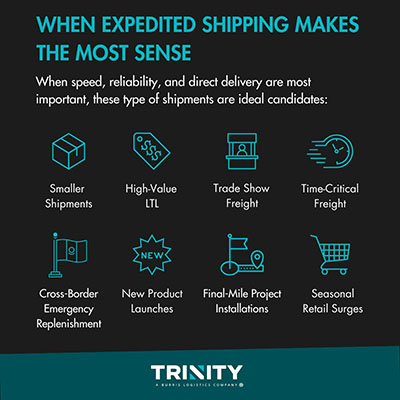
Adding expedited freight shipping into your plan is great, but not every kind of freight needs to be expedited. This shipping method tends to be pretty specific.
It’s ideal for:
- Smaller shipments
- Time-critical freight
- High-value LTL
- New product launches with fixed release dates
- Trade show freight that must arrive on time
- Seasonal retail surges
- Final-mile project installations
- Cross-border emergency replenishment
Think single pallets, critical components, tools needed on-site, freight that requires minimum handling, or inventory that must hit a shelf by a certain date.
When speed, reliability, and direct delivery are most important, these types of shipments are ideal candidates for expedited service. Used this way, expedited shipping isn’t reactive at all. It’s part of the plan.
Why Expedited Freight Shipping Moves Faster
One common misconception about expedited shipping is that it moves faster because the truck is faster, but that’s not true. Expedited shipping is faster than LTL or regular truckload because you’re removing friction.
There’s no waiting to build a full load before it can ship. No partialing or extra stops along the way. It just moves. And depending on the equipment, there can be fewer regulatory constraints, too.
Cargo vans often operate under different regulatory thresholds than larger trucks, which means they aren’t always subject to the same hours-of-service (HOS) rules. That flexibility can allow for more continuous transit, especially on long hauls.
That’s where team drivers come in. With two drivers alternating, the truck can keep moving while staying compliant, closing the gap on transit time in a big way.
And then there’s route planning. Legal drive time, traffic patterns, or weather all factor into whether transit time is actually realistic.
Expedited freight shipping isn’t about just finding a truck for a fast delivery. It’s about building a plan that holds up to your unique needs.
Sprinter Van? Or Straight Truck?
Two of the most common types of equipment used in expedited shipping are sprinter vans and straight trucks.
Here’s where expedited shipping can be a little complicated. On paper, they can look pretty similar, but in reality, they serve very different purposes.
Sprinter Van
Dimensions
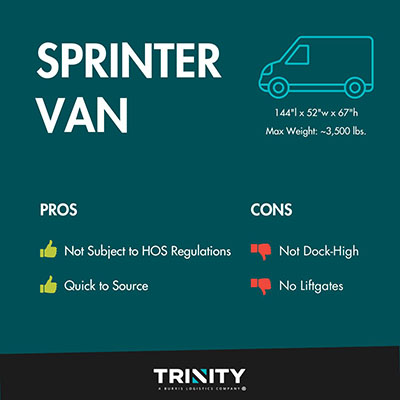
A sprinter van is built for speed and flexibility, so you usually work with a smaller footprint. Its interior dimensions are roughly 144 inches long, 52 inches wide, and about 68 inches high with a maximum weight capacity of about 3,500 pounds. It’s enough space for a few pallets or loose freight.
Pros
One of the biggest advantages of sprinter vans is their operational flexibility. Sprinter vans are not subject to the same HOS regulations as truckload drivers. This allows drivers to operate continuously without mandatory rest periods, resulting in sprinters being able to cover long distances faster.
Sprinter vans are usually quick to source, easy to be maneuvered, and ideal when time is tight, and the shipment is light.
Cons
Sprinter vans aren’t dock-high, nor do they come with liftgates. If your delivery requires either of those, then a sprinter van may not be the best choice for your shipment.
Straight Trucks
Dimensions
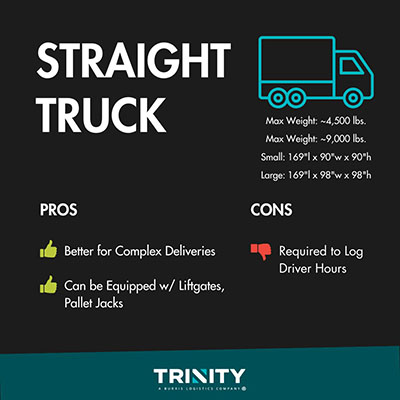
Straight trucks open things up quite a bit. Smaller straight trucks average around 169 inches long, 90 inches wide, and 90 inches tall, and can handle around 4,500 pounds.
Larger 24–26-foot straight trucks can move close to 9,000 pounds, with significantly more interior space – around 98 inches wide and 98 inches tall. Occasionally, you’ll find some straight trucks that can handle 10,000 – 12,000 pounds, but they are more difficult to source in a timely manner.
Pros
Straight trucks are the better option for expedited shipments that have more complex deliveries. They’re able to be equipped with liftgates, pallet jacks, and several other tools to work in those kinds of situations.
Cons
Straight trucks, in most cases, are required to log driver hours, which can impact transit time on longer runs.
Ride Quality, Protection, & the Details That Matter
When you’re moving high-value or sensitive freight, speed is only part of the equation. Ride quality matters too.
Air ride suspension can be a must-have for certain shipments, but it’s not standard across all expedited equipment. Sprinter vans don’t offer it, although their suspension performs well for most freight. Straight trucks may have it, but it typically needs to be requested upfront.
It’s one of those small details that can turn into a big issue if it’s overlooked.
Expedited Ground vs Air – Not Always What You Think
Air freight has the reputation for being the fastest option – and sometimes, it is. But not always.
There are plenty of situations where a sprinter van, or a team-driven straight truck, can match the delivery window without the added complexity of air. Ground expedited shipping also avoids many of the logistical complexities, requirements, and potential delays associated with air transport.
In many cases, expedited freight shipping can be a more practical and more cost-effective solution.
A Smarter Way to Think About Expedited Freight Shipping
It’s easy to think of expedited as the backup plan, but it’s also a great way to:
- Have more control
- Move quickly without creating new problems
- Maintain customer commitments
- Protect freight that doesn’t have room for error
That’s how we approach the shipping solutions we have here at Trinity – more than just a backup plan. Instead, they’re critical parts of your competitive strategy. (Of course, if a backup plan is what you need at the moment, that’s okay, too!)
And with expedited freight shipping, speed depends on access – not just to trucks, but to the right ones.
At Trinity, we work with a network of vetted, relationship-driven carriers who understand urgency, communicate clearly, and follow through.
Whatever your logistics needs are, we’ll take the time to understand them and build a solution to meet your business goals. Rather than forcing your shipment into a standard process, we prefer to work with your priorities, helping you bring more strategy into your operations, not just speed into your shipments.
That’s the difference between reacting in the moment and being ready for what’s next – and it often comes down to who you have in your corner.
Request a Quote to get started with Trinity Learn more about Trinity's expedited services